Category Archives: Exhibits

Ruth Laxson. Biking. Rilke.

I just returned from 10 glorious days south of the Mason-Dixon Line in sunny Georgia. Doug and I drove the 1000+ miles with our bicycles through snowstorms for a week of incredible mountain biking at Mulberry Gap in the Georgia Mountain Bike Capital Ellijay. But before we took to our bikes, we spent a weekend with my brother and his family in Atlanta. What fun to see him and his two boys.

Country mouse in the big city, I had to make time to check out two amazing art exhibitions. Ruth Laxson–one of my favorite contemporary artists– at the Museum of Contemporary Art (MOCA), and Frida and Diego at the High. I knew about the Laxson exhibit, Hip Young Owl, and learned about Frida and Diego from the billboards lining the highway as we drove into the city.

And not only was it a glorious day of art, when we arrived at MOCA, Ruth Laxson was leaving, so I got to meet and talk with her a bit before viewing the exhibit.

Meeting Ruth Laxson

Meeting Ruth Laxson

Laxson is a well-known book artist and printmaker in certain circles. I discovered her work in grad school. She came into her own in her 60′s. She’s now 89 and shows no sign of stopping!

Pasted into one of Laxson's sketchbooks.

Pasted into one of Laxson’s sketchbooks.

Text, texture, image, thread, mail, dots, paper and commentary on the human condition define her work. Her newest series, drawings entitled God Doll’s, drew me into her visual language. Her use of repetition, automatic writing as texture yet also an important part of her composition–a framing device, a ground, a form–the figure, not as we know it, but as it forms from the shapes, textures and marks she creates. There’s a freeness and openness to these figures that brings me to her world. When looking at her work, those who know my work understand immediately why I love this artist’s creations.

What I did not know was the role of mail art in Laxson’s career. In the 1980s she participated in numerous mail art exchanges and did so for many years. She even has a series of mail art post boxes that were included in the exhibit. Maybe, if I’m lucky, I’ll be like her when I’m 89. I got my press at 41, she got hers at 63. So maybe there’s hope for me!

Here are some of my favorite images from the exhibit:

After a couple of hours of soaking in all that is Hip, we headed over to the High to see the Frida and Diego exhibit. Many of the paintings on view were ones that I had never seen. It focused a bit more on Diego than Frida, including many of his earliest paintings, paintings when he hadn’t found his own visual language and was still copying that of Picasso, Cezanne and other artists at the start of the 20th century. Many of the pieces in the exhibit were not only new to me but also zeroed in on Frida and Diego’s tumultuous relationship. In spite of their many ups and downs, she made this wonderful little piece for him in honor of their 15th wedding anniversary. It was one of my favorite images in the entire exhibit.

Frida's gift to Diego in honor of their 15th wedding anniversary.

Frida’s gift to Diego in honor of their 15th wedding anniversary.

Of course Doug and I had to take part in the camp that often surround Frida and Diego.

IMG_1347

But regardless, this day of art, then time with my little brother and his family, followed by an incredible week of mountain biking keeps me thinking about this Rilke writing from March 14th in A Year with Rilke.

Praise the World
Praise the world to the angel: leave the unsayable aside. 
Your exalted feeling do not move him.
In the universe he inhabits you are a novice. 
Therefore show him what is ordinary, what has been
shaped from generation to generation, shaped by hand and eye.
Tell him of things. He will stand still in astonishment,
the you stood by the ropemaker in Rome
or beside the potter on the Nile. 
Show him how happy a thing can be, ho innocent and ours, 
how even a lament takes pure form,
serves as a thing, dies as a thing,
wile a violin, blessing it, fades.
 
And the things, even as they pass,
understand that we praise them.
Transient, they are trusting us
to save them–us, the most transient of all.
As if they wanted in our invisible hearts
to be transformed
into—oh, endlessly—into us. 
                                   From the Ninth Duino Elegy

Eye-candy exhibits that I want to see this year

But alas, it will be impossible to see some of them, due to their location and timing.

Still, at least I can vicariously see some of them through catalogs and websites. And I can’t wait.

Ruth Laxson’s Hip Young Owl

Ruth Laxson, Hip Young Owl, Museum of Contemporary Art, Atlanta (I just saw this over the weekend. More about it in a future post!)
 
Life’s Work, MASS MoCA, North Adams, MA
 
Gravity and Grace: Monumental Works by El Anatsui at the Brooklyn Museum, Closing August 4
 
James Turrell at the Guggenheim, New York, June 21-September 25
 
Balthus: Cats and Girls at the Met, New York, September 2013-January 2014
 
Janet Cardiff: The Forty Part Motet, Cloisters, New York, September 10-December 8 (The link here takes you to a review of the installation documentation on the artist’s website.)
 
Paul Klee at the Tate Modern, London, October 15, 2013- March 9, 2014
 

Woodshed 2013

100 Hours in the Woodshed is a biannual event hosted by Danny O at MCLA’s Gallery 51. This is my third year as a participant. It begins with an opening reception/meet the artists from 5-7 pm on Thursday night, followed by three hours of art-making. We all leave around 10 pm and return on Friday and Saturday at 10 am working until 10 pm. Sunday we come back for eight more hours, again beginning at 10 am and this day working until 6 pm. At that point we strike the set, break down the tables, pile up the art and wait.

Monday, Ryder Cooley, G51′s new gallery manager and Susan Cross, MASS MoCA curator come onto the scene to curate the exhibit, and then it gets installed. Tuesday, like in two days Tuesday, the show opens to the public, from 5-7 pm. Hope to see you there!!

Please come. Please come to see the book I made. And the other stuff too, but I love this little book. I love everything I made. I haven’t been this excited by work I’ve made in ages. The book uses a structure that Alisa Golden is trying to get everyone who makes it call it the Australian Piano Hinge instead of Flat-Style Australian Reverse Piano Hinge binding. I agree with her. I saw the instructions for this on her blog and have been wanting to make it, and this weekend allowed me that opportunity.

Back of the book QUEST

Back of the book QUEST

Quest pages 1-2

Quest pages 1-2

QUEST pages 3-4

QUEST pages 3-4

QUEST pages 5-6

QUEST pages 5-6

QUEST pages 7-8

QUEST pages 7-8

Two important things happened for me this weekend.

1. It was confirmed to me, something that I already know and have read in countless books on creativity, that inspiration doesn’t just happen. Sure there are those moments of insight, but regular, focused work breeds inspiration. By the time I reached 29 hours into the event, two big huge connections happened. One–that one of the things I am doing in the collages that I really like is pairing the flat with the dimensional. This opened up a huge flood of visual connections and the opportunity to create more mindfully. Two, that the way to bring the God thing that I sort of haphazardly stab at here and there is by going back to the pages and pages of notes and writing that I did while earning my Master’s in Religion at Yale–and picking out text from that writing instead of the more cliche attempts that I’ve been making lately.

2. I am ready to move forward from events of two years ago. (If you know, you know. If you don’t–well, just know that I was very sad two years ago, and that sadness is really, finally and completely lifting. Don’t ask me about it.) While the raven will still be seen from time to time, there is a lightness emerging in my color and image choice that I haven’t seen in years. I even am consciously choosing to work with yellow. Unheard of for me. (Not that you will see it in this imagery, just trust me.)

Here’s the other work I made. I’m thinking it would be very much fun to cancel classes tomorrow, stay home and continue working, but I know I won’t be able to give into that urge. But maybe another day this week…

The work ist better in person–the light wasn’t so great today for these pics. I’ll do my best to update with clearer ones, so come on Tuesday so you get the best view!

Go

Go

Follow

Follow

I shall be released

I shall be released

Six collages, the top middle one is my favorite.

Six collages, the top middle one is my favorite.


Meditation begins with little dots

About a month ago Doug and I spent the weekend at Kripalu participating in a great retreat about meditation with Sharon Salzburg. I first discovered Sharon Salzburg and her book Lovingkindness nearly ten years ago when I was trying to figure out if I should stay at Buxton teaching art or take the risk and go back to grad school to earn my MFA. (I took the risk!)

This retreat found us doing sitting and walking meditations, practicing metta and doing some slow, restorative yoga. I often beat myself up for how easily distracted I can be, but I took away two powerful things from this weekend.

1. The beauty of Metta, and practicing it regularly for myself, for my loved ones, for those who challenge me, for my perceived enemies, for all beings. I practice it for 15 minutes most days–five minutes for myself, five minutes for someone I will interact with later that day, and then five minutes for anyone who happens to come into my mind, friend or foe.

May you be free from danger.
May you have physical happiness.
May you have mental happiness.
May you have ease of well-being. 
 

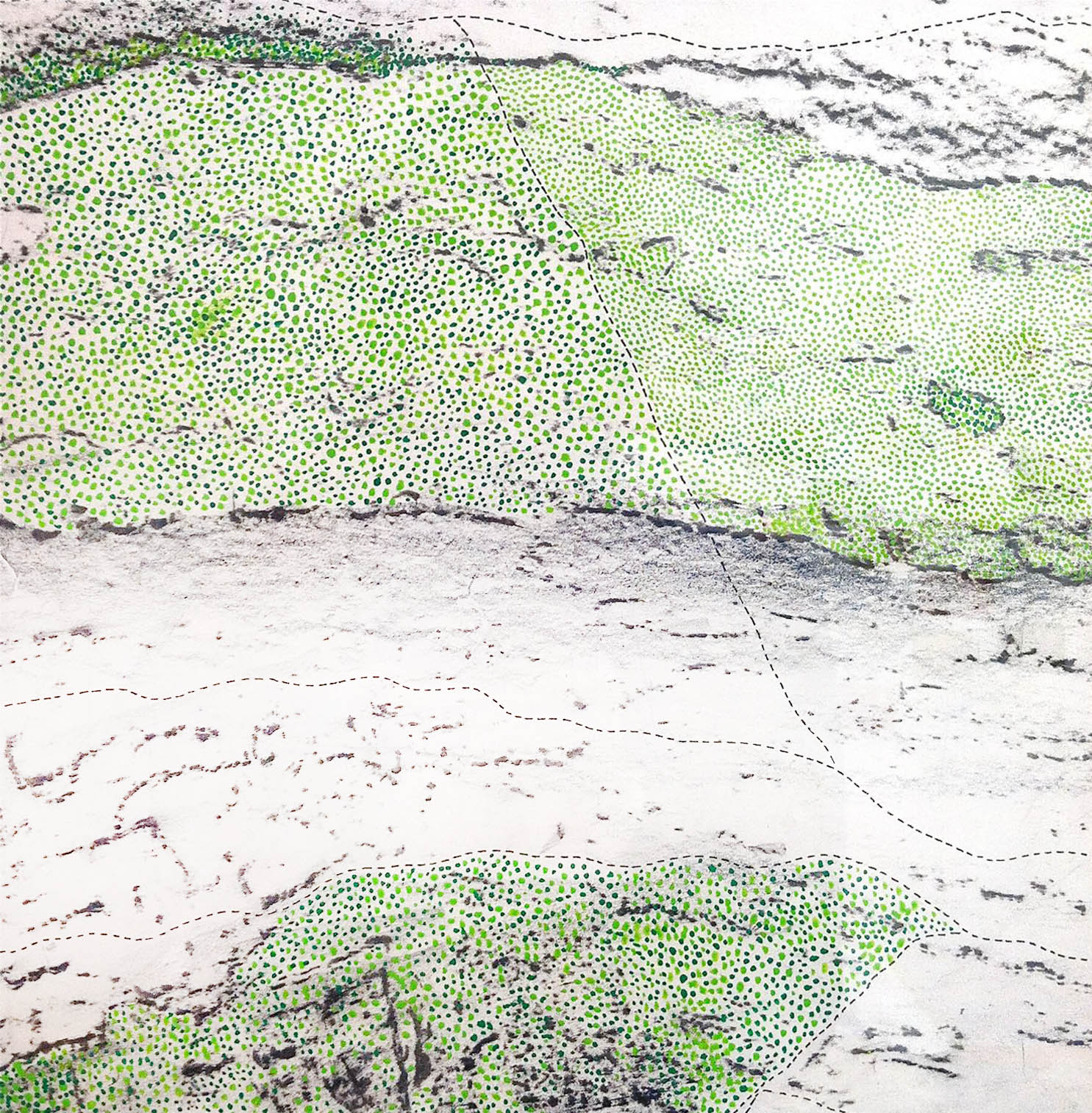
2. That I actually can focus, and sometimes so well that I don’t hear people talking to me, I forget to eat and frustrate my loved ones because I am so focused. This usually happens when I am in my studio. And yes, I realized that in many ways this is meditating for me. I can often even feel my pulse slow, my mind zero in on the work and everything else drop away. When I teach, I have to be careful when I demo because I can drop into this state pretty quickly. This weekend, I reached this state quite a bit as I worked on my selection for Gallery 51′s upcoming 99cent and up show. Tree rubbings with little green dots and pathways. Bliss.

Here’s a preview:

I hope to see you there!

Branching Together

Branching Together opens tonight at Gallery 51 in North Adams!

Branching Together unites the work of Helen Hiebert, Sun Young Kang and Michelle Wilson, three artists who work with paper. Each artist is on a journey, a path, a way that branches together and outwards to others. Trees with their branches and roots, reach out to life and death, and invite the viewer to walk the path, the way between. They each engage the viewer, ultimately asking what are the paths that we walk, as child, mother, and citizen? Handmade paper, made from the earth, serves as the primary medium linking these works. But each artist transforms this everyday material into an artwork that invites the viewer to see their reflection and find moments of connection in their own life.

The centerpiece of the exhibit, Mother Tree, is a visual and emotional journey made tactile with natural fibers and was conceived by Helen Hiebert and serves as a symbol of the vulnerability, strength, and sense of community she feels as a mother.

Mother Tree by Helen Hiebert

Mother Tree was created with translucent abaca-based paper. Strands crocheted from cotton, linen, hemp and flax form the roots. Some of these strands are crocheted by Hiebert, many more are crocheted from others who read about her project online or experienced it at a gallery. Contributors include notes with their strands. The strands represent milk, and as Helen explains, “as the milk cascades to the floor, it turns into roots and these roots are multi-colored and multi-fibered, representing all of humanity and our diversity. The threads in Mother Tree symbolize the lifeline that connects all women to their past as well as to their future.”

Like Mother Tree, To Find the One Way, by Sun Young Kang, also begins with a personal experience, her response to the death of her father, and the inseparability of life and death that connects us all to our ancestors and our children. She too, explores these lifelines that connect us all to our past, as well as our future. To Find the One Way is inspired by the Buddhist idea of the number 108 and the renderings of the character  (Tao), which has various meanings, including “path” or “way.”  Kang extends the play with the number 108 by extending it to 1080 pieces of paper, all marked with the  (Tao) character.

To Find the One Way, Sun Young Kang

Kang used burning incense to make the negative space on each page, creating absence, which represents death or loss. When lit, the absence creates a shadow. This shadow has triple significance; it draws attention to the negative space, and the absence the space suggests, and it calls to mind memories of the one who is absent. Every character of emptiness on the paper creates 1080 different ways or paths. Each of the paths connects absence and presence, the past and the now, the loss and the memories, and death and life, lifelines of dualities between which we all journey.

Michelle Wilson, also uses absence in The Ghost Trees. Wilson aims to find the intersections in one’s lifeline where thought takes action, where one decides along the way to make a stand. In her case, the stand represents her love of nature, and the ecological links that paper inherently represents. Through the use of watermarks, this installation creates a “haunting” in the paper itself, evoking the immense deforestation that occurs every year to keep up with the demand for paper.

Ghost Trees, by Michelle Wilson

The lines, paths and ways created by fiber, paper and shadow that each of these artists create branch together as they journey from birth, through life and into death. Where are the places inside of each of us that mother, that mourn, that take a stand? How do they branch together in you? How do they branch together in me? How do they branch toward each other, bringing us together as we journey in this great community of earth? I ask you this as the curator, to think about this as you experience this exhibit, what is your path? How is it part of this greater communal journey of birth, life and death?

Be sure to join me on March 22nd for a crochet/knit night at Gallery 51. Come crochet/knit a root for Mother Tree.

Did I tell you I’m reading my poetry on Thursday?

This Thursday, now to take place at Gallery 51, I’ll be participating in the inaugural reading of the PRESS POETRY SERIES. Jason Peabody, the summer associate gallery manager and current marketing and outreach intern, has put together this fabulous event! (Thank you Jason!!) It looks like a great line-up! Abbott Cutler, Barry Sternlieb and Hannah Fries! We’ll begin at 7:30 p.m. at Gallery 51 and it will be followed by a reception with refreshments at PRESS.

I’ll be reading some poems about running, many date back from memories of running in the Caribbean. The ones I’m reading are a bit dark. The poems about blissful running are still being written. Maybe I’ll have them ready at our reading in March…keep reading my blog for updates! But in the meantime, if you plan on coming on Thursday, email us letterpress105 [at] gmail [dot] com.

The Venice Biennale

I am a lucky woman. I attended Art Basel and the Venice Biennale this year. Somehow I managed to squeeze this trip into the middle semester, doing what I do best, getting every moment out of every moment.

Here I am about four hours after landing in Venice at one of the collateral events. These events take place in various apartments, churches and palazzi all over the city. One must traverse bridges and figure out which of the tiny alleys to take to find the event. OR, sometimes as you walk, you just discover one of them, and you find yourself in a building with very few people (a rarity at this time of the year in Italy), someone playing the piano, and a mix of contemporary and classic art.


Here’s a great review of the Biennale from the New York Observer. I completely agree with Lindemann when he says, “The portions of the Biennale curated by Bice Curiger (the primary curator of this year’s Biennale) —the Arsenale and the “Italian pavilion”—were both disappointing.” Very few pieces stood out, craft was often questionable, and I was only interested in Christian Marclay’s movie, The Clock, which won the Golden Lion.

Lindemann also goes on to remind us in his review that just because the Biennale is curated, doesn’t mean that nothing is for sale, that just as much buying of art happens during the six months of this epic extravaganza as at any fair, if not more.

I had a great time, at least momentarily, in the American Pavilion. The United States was represented by Jennifer Allora and Guillermo Calzadilla. A husband and wife duo, chosen for their performance art pieces and experimental practices, and not for their commercial appeal. One of their pieces featured an ATM embedded in a sculpture of church organ pipes. Random sounds emanated from the pipes when “patrons” withdrew money. Pretty gimmicky. Pretty silly. Read the NYTimes review here.

I could go on–maybe I will in another post. But I know this, I hope I get to go 2013.

Why the bird?

Someone asked me the significance of the bird in North Adams yesterday. The visitor was making connections between the birds in all of my work right now–and the Mike Glier giant grackle at the Porches Inn. My work is completely unrelated to Glier’s, and both are not, at least to my knowledge, related to North Adams.

My bird imagery relates to ideas of nesting and rebirth. I imagine the womb as a nest and an incubator for creative ideas, not just babies. I also see it as a gestation place for learning, gaining strength and life. The nest/bird/baby/idea that grows there then must come out somehow–through song, creation, and birth.  The bird inside and outside of the body outline tries to express this.

I then weave tree imagery with the bird to suggest other relationships. Sometimes it’s fear and darkness, which the forest often is. Sometimes it’s comfort and peace, which the forest also is.

Rilke comes to mind too, here’s a piece from Rilke’s Book of Hours, translated by Anita Barrows and Johanna Macy:

How surely gravity’s law,
strong as an ocean current,
takes hole of even the smallest thing
and pulls it toward the heart of the world.
 
Each think–
each stone, blossom, child–
is held in place,
Only we, in our arrogance,
push out beyond what we each belong to
for some empty freedom.
 
If we surrendered
to earth’s intelligence
we could rise up rooted, like trees.
 
Instead we entangle ourselves
in knots of our own making
and struggle, lonely and confused.
 
So, like children, we begin again
to learn from the things,
because they are in God’s heart;
they have never left him.
 
This is what the things can teach us;
to fall, 
patiently to trust our heaviness.
Even a bird has to do that
before he can fly.
 

 Trusting the heaviness, trusting in general, and being patient with that process is crucial for any of us to fly–to whatever it is that we need to be or do in our lives. This bounces back and forth in my brain as I create, hoping that I’m making the connections visually that will resonate for me and for others. Look for a post in the next week with some of the more recent prints that continue to explore this.

Art Basel

Ah, a week in Switzerland! With eight MCLA students and my colleague Jonathan Secor with the goal of seeing and doing everything Art Basel. This incredible opportunity is the result of a various generous donor who charged the college with creating unique and life altering opportunities for students. I’ve been honored to be one of the faculty on two of these trips. Our first trip was in 2009 to the Venice Biennale. This year, we decided to go to Art Basel for a different sort of art immersion trip.

As a result, I can now compare the two potentially biggest art gatherings in the world. And while I thoroughly enjoyed my experience in Basel, it is not without significant criticism. I live is a wonderful art bubble in western Massachusetts that is dominated by women. My particular field, book arts and printmaking is filled and led by many strong women. It is very easy for me to forget that this is not the case in many art circles. I was reminded of this again and again at Art Basel. It is a very western, white male dominated event. (Like much of the art world.) During my prep for the trip, I came across a number of articles that suggested that this particular Art Basel gathered representatives from around the world, with a much larger selection of galleries and collectors from Asia and the Middle East. These numbers were not evident. Going through the catalogue of Art Basel and many of the parallel events brought up the same locations every time: USA, Germany and other European countries. Yes, a few galleries from South America, China, Thailand, etc. But not remarkable numbers.

The Biennale certainly has it Eurocentricness as well, but it makes more of an effort to really focus on the best art and experimental art from all around the world. Art Basel is about making money–selling the work of established artists, and showcasing here and there some more up and coming artists. Acquiring the art becomes a great prize, or trophy. (You don’t buy or purchase art, you acquire it!) And boy did I have fun pretending that I was going to acquire some great art! I paged through a portfolio of Louise Bourgeois prints that could be mine for a mere $500,000. It put a different sort of meaning to my upcoming PRESS project.

One of the more entertaining evenings found us out down by the Rhine for the Art Parcours evening fun. Local beer, local bands, art from around the world. Including a performance by Chris Johanson and his band on a barge in the middle of the Rhine. Great times were had by everyone, as we walked from installation to installation.

Art Basel is divided into a few different sections–the main event: Art Galleries–nearly 300 of the “world’s” top galleries, selected from 1000+ applications. There are other sections, Art Editions, Art Features, Art Unlimited and Art Statements. The last two are the most like the Biennale. Art Statements features one-person stands of emerging artists, and Art Unlimited features one-person stands of established artists and large installations. Some of the work was fantastic, some of the work, well, let’s just say it didn’t move me. But that’s true at any art fair/show/museum.

If given the opportunity to go to one of these shows again? I would easily choose the Biennale. Certainly Venice is more magical and has much better food, and to me represented women, people of color and the global art scene better. I often ask my students to be aware of the lens they wear when they look at art. To question and analyze all the time, and to pay attention to their own biases. Can you tell mine from reading this post?